

Written by:
peru.travel
Friday, November 27, 2020
In this Page
An architectural jewel of the ancient Peruvians, the Kuélap fortress is distinguished by its monumental character and the complexity of its location. Its historical importance lies in the fact that it allows to know in detail the history of the Chachapoyas: a society that reached a cultural splendor long before the Inca Empire. Kuélap is, without doubt, the most admirable testimony of the northeastern Andes of Peru.
Visiting this ancient city consists of a journey where you will not only discover part of the pre-Inca history of this country, but you will also come into direct contact with nature and the mountainous jungle of the Amazon region. Located in the Tingo district, this treasure of construction and architecture awaits your visit: an experience that will be very enriching and unforgettable.
Bastion in the heights
Located at 3000 meters above sea level, on top of a mountain that dominates the narrow valley of the Utcubamba River, this imposing fortress, six hectares in size, is one of the largest in America. It was discovered in 1843 by Juan Crisóstomo Nieto, then a judge of Chachapoyas, during an expedition through the area. After three hours of exploration, Nieto saw the walls of the great complex in the distance, covered with vegetation and practically intact.
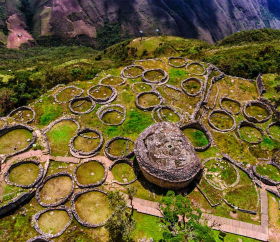
The place has 420 houses with a circular shape and sloping thatched roofs. The outer walls, made of stone and mud, are of different heights and the highest walls reach up to 20 meters. Its special location was intended to facilitate the work of its defenders, who practically only had to worry about taking care of one side of the building, in addition to having a panoramic view of the entire valley.
The defensive mounting is complemented by two towers located to the north and south of the complex, and narrow hallways designed so that eventual invaders could only advance in a single line. Remains of stone axes and sling shells have been found near, which evidence the fights that occurred in this place.
The interior enclosures do not have windows and on their fronts, decorative friezes with anthropomorphic figures can be appreciated. El Tintero draws attention, a building finely carved in stone with more than five meters high and an underground room six meters deep.
Construction geniuses
The Chachapoyas culture was made up of different indigenous communities, each administered by its own curaca. They settled in areas of the Sierra and jungle between the Marañón and Huallaga river basins. In the rugged territory they occupied, the Chachapoyas dedicated themselves to the cultivation of corn, potatoes, olluco and mashua. They were great artists of construction and architecture, as can be seen in the archaeological complexes of Kuélap and Gran Pajatén.
The construction of Kuélap was a great challenge for the Chachapoyas because of its location and the amount of material that was required to build the fortress. The walls are made of limestone, worked with yellow clay. It is estimated that just to raise the two main walls, more than 100,000 blocks of carved rocks were required, weighing more than 10,000 tons.
Another problem they had to solve was the water supply. For decades, this was a mystery to researchers. Only in 1965, underground water was discovered in the fortress, confirming the existence of a water spring near the site.
Getting there
To get to Kuélap you must travel by plane from Lima to Chachapoyas, with an hour and 45 minutes of flight. You can also go to other nearby cities like Tarapoto, Jaén or Chiclayo, and then continue with the tour by land. Another alternative is to go directly by bus: from the Peruvian capital it is between 22 and 24 hours of travel through the cordillera.
Once in Chachapoyas, you have to go to the town of Nuevo Tingo. The buses take an hour to arrive. Then, you will have two options to arrive to Kuélap: by cable car or on foot.
If you like trekking, consider bringing plenty of water and comfortable shoes to do the arduous walk of more than 3 hours. The recommendation is to arrive a day before so that you can acclimatize and avoid soroche. If you choose to go by cable car, the travel time to tourist stop La Malca is 20 minutes. Then, you only have to start a walking route of only 30 minutes to the archaeological zone. To enter the fortress, you must pay a ticket that varies depending on whether you are a Peruvian resident, foreigner or student. Come and visit this architectural treasure!
Sources: Arqueología del Perú / El Comercio / Telecabinas Kuelap / Red bus / Peru hop
Follow us on social media
Facebook | Instagram | Twitter | TikTok | YouTube