
Written by:
peru.travel
Tuesday, April 27, 2021
In this Page
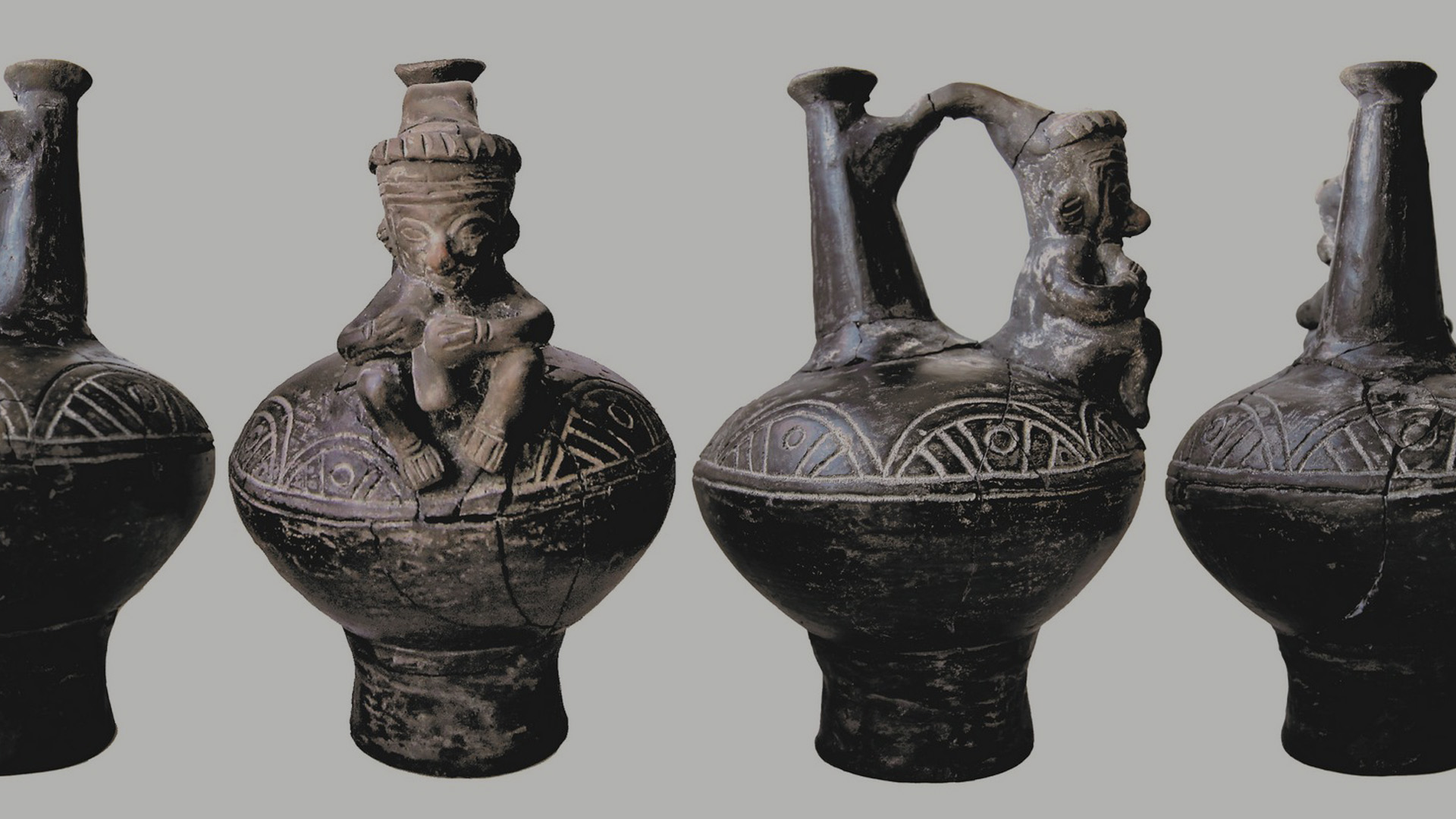
While cleaning out the attic of a house in a village in eastern Poland, they came across a dark ceramic dish on which there is a depiction of a seated person holding what is believed to be an instrument. The piece which, according to some experts, belonged to the Chimú Culture, was donated to the Biłgoraj Museum.
The museum director, Marek Majewski, reported that the pottery arrived in fragments and the archaeologist, Konrad Grochecki, had to reconstruct it. It was then analyzed and it was concluded that it is a Peruvian dish dating back more than 1,000 years.
"At first our archaeologists thought that the shattered ceramic was an example of folk art. After putting it back together, it turned out that it is a find which is uniquely valuable in the scale of Europe." Majewski said.
An incredible find
The collected information was supported by the Krakow Archaeological Museum, the oldest in Poland, which houses artifacts from the same period and which also present the style of this region.
The dish is just under 12 inches in height, and 10 inches at its widest part. The base is decorated with semicircles filled with diagonal lines.
According to Konrad Grochecki, director of the Krakow Archaeological Museum, this is a magnificent find.
"It comes from South America, more precisely from what is today the area of Peru. It is very likely that the piece is related to the Chimú culture that emerged at the beginning of the 10th century. It is undoubtedly an incredible discovery, an enormous rarity, as there are very few of these collections in Europe. I hope that in the future we will be able to date the object more accurately and gain a better understanding of the scene that is depicted."
From Peru to Poland
Although it certainly comes from South America—more specifically, Peru—researchers have been racking their brains as to how this item originally came to Poland. One of the theories is that it was brought in the 19th or early 20th century by Poles working for the Peruvian government.
One of these workers would be the engineer Władysław Kluger, who amassed a large collection of items from the second half of the 19th century, some of which are now on display in the Archaeological Museum in Kraków.
About the Chimú Culture
Its development and peak took place after the Mochica Culture between 1000 and 1400 B.C. The Chimú people settled on the northern coast of Peru with Chan Chan (in the Moche Valley of present-day Trujillo) as their administrative center. Chan Chan became the largest adobe city in the Americas.
The culture is known for its distinctive monochromatic pottery, often depicting creatures or human figures sitting or standing on a cuboid bottle.
Sources: The First News
Follow us on social media
Facebook | Instagram | Twitter | YouTube