

Written by:
peru.travel
Thursday, November 19, 2020
In this Page
Would you dare visit one of the city's most gloomy landmarks?
Following the Spanish conquest, churches and convents began to be built and decorated throughout Lima. Wealthy families and viceroys contributed financially to these projects and, in return, were granted burial sites beneath these religious buildings during the colonial period.
Situated beneath the San Francisco [Saint Francis] Church and Convent in Lima, the Franciscan crypts served as the final resting place for more than 25,000 people who were buried there to feel closer to heaven or to God. This practice continued until 1808, when Lima's new open-air cemetery was inaugurated, moving burials away from beneath churches. The cemetery was named Presbitero Matias Maestro [Presbyter Matias Maestro] after the architect who designed it.
1. Architectural gem
The Saint Francis Monumental Complex in Lima comprises the Church and Convent of Saint Francis de Jesus el Grande de Lima, alongside the chapels of the Virgen del Milagro [Virgin of the Miracle] and the Virgen de la Soledad [Our Lady of Solitude]. Its construction began in 1546 and was completed in 1672, with its cloisters, galleries, and churches forming this viceregal religious complex.
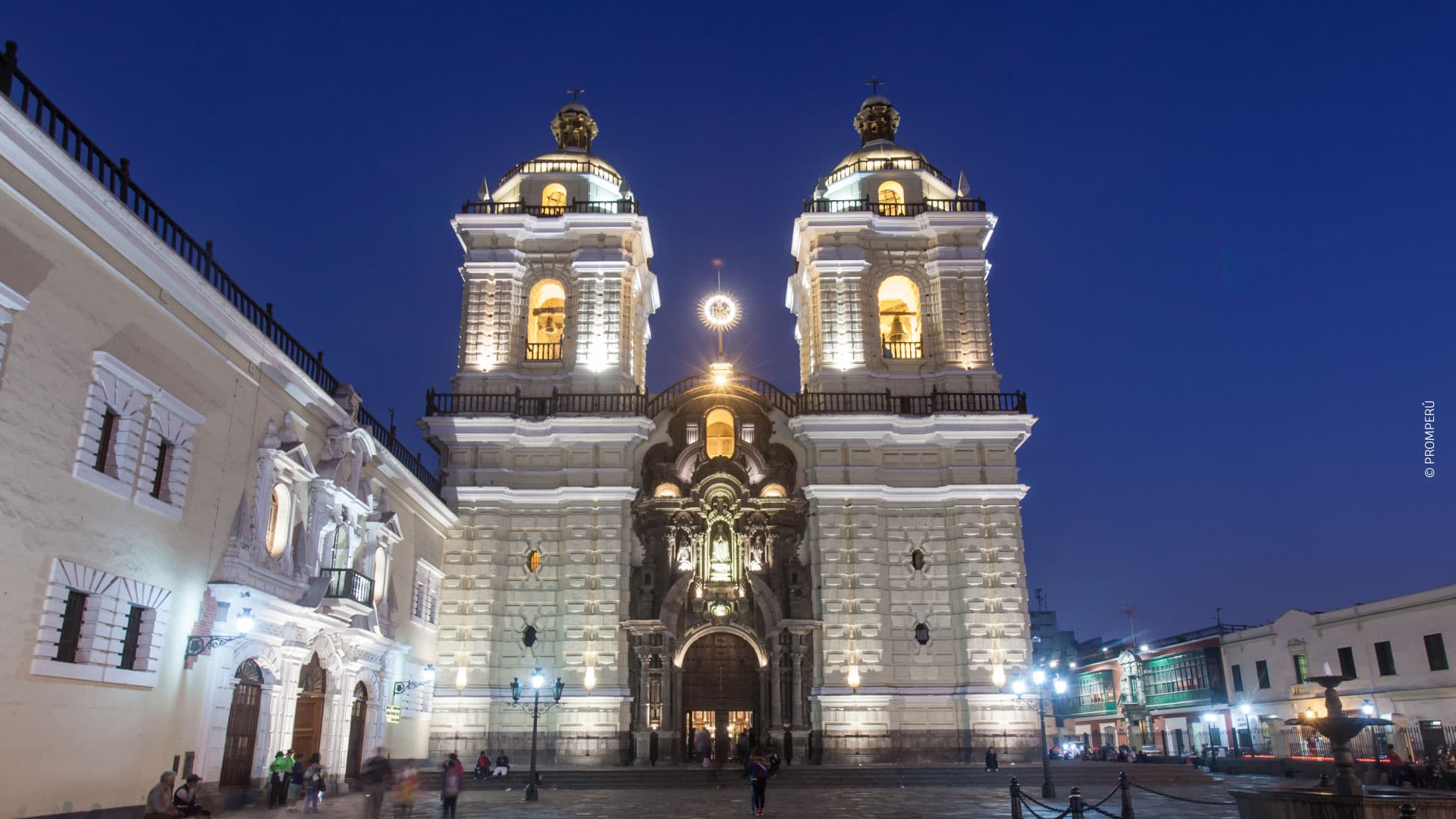
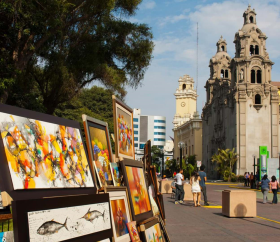
Convent of Saint Francis, Historic Center of Lima / ©PROMPERU
The Saint Francis Museum in Lima houses a remarkable library with more than 20,000 volumes on theology, philosophy, sermons, bibles, history, literature, among others. This collection was essential for the training of the friars responsible for spreading the Catholic faith among the Indigenous peoples of Peru.
It also features a cloister with galleries decorated with a wide variety of tiles made in Seville, Spain, in the Triana district, by artisan Hernando de Valladares in 1620. The site also contains paintings from the workshops of renowned 17th-century artists such as Francisco de Zurbaran and Peter Paul Rubens.
A visit to the monumental complex offers a glimpse into the communal living spaces of the friars, their religious training required to spread the new faith, and the vital role art played in this mission. Since Indigenous peoples of Peru did not speak Spanish or Latin, paintings and sculptures became the primary tools for conveying the faith, alongside the viceregal practice of burying the deceased beneath churches and convents.
2. Seismic-resistant structures
Viceregal architecture underwent significant changes in construction materials due to frequent tremors and earthquakes. It shifted from stone—the bedrock of European architecture used during the early colonial period—to quincha [a blend of adobe, cane, wood, and plaster]. Beneath the church, a series of pits up to five meters deep were built to help dampen seismic waves, reducing their intensity and minimizing damage to the religious structures.
Later, due to a lack of space in the crypts, the skeletal remains were transferred to these pits. These were turned into ossuary wells or mass graves, where the largest and most durable bones of the human body, such as skulls and femurs, became the most prominent remains.
3. An underground network
This burial custom was not only practiced beneath the churches of the major religious orders, such as the Cathedral, Saint Francis, Santo Domingo [Saint Dominic], San Agustin [Saint Augustine], La Merced [Our Lady of Mercy], and San Pedro [Saint Peter], but also in smaller churches and chapels throughout the city center and Barrios Altos, including Santa Ana [Saint Anne], Los Huerfanos, among others.
Hospitals located along the edges of old walled Lima also carried out these underground burials. Unfortunately, most of these buildings have disappeared over time, with the former San Andres [Saint Andre] Hospital in Italia Square remaining as an example, where recent archaeological excavations are currently underway.
There is a theory that, due to the proximity of these churches, they may be connected by underground passages. However, studying or excavating them would require a substantial budget, as well as permits from the Ministry of Culture, the Municipality of Lima, and the owners of the historic mansions through which these passages would run. These requirements currently make such excavations impossible. For instance, the Church of Desamparados [Our Lady of the Forsaken] was demolished to expand the current Government Palace, yet its burial crypts still survive beneath the gardens of the presidential residence.
4. Illustrious deceased
Before entering the Saint Francis crypts, there is an area where several Franciscan friars declared venerable were buried. This means that, during their religious lives, they performed many virtuous acts and earned merits that could eventually lead to their beatification and later be canonized as saints.
Among these figures is Friar Juan Gomez who served as a nurse for 40 years and cared for Saint Francis Solano from 1604 to 1610. Also laid to rest here is Friar Ramon y Tagle y Bracho, a member of the family of the Marquises of Torre Tagle. Another notable figure is Friar Andres Corso, who, alongside Saint Francis Solano, helped establish and build the first structures of the Convent of Nuestra Señora de los Angeles [Our Lady of the Angels] (Los Descalzos)
Also buried here is Friar Jose Francisco de Guadalupe Mojica, a Mexican Franciscan friar. Before entering religious life, he was a successful opera singer and Hollywood movie actor who abandoned everything to become a Franciscan friar.
Many other notable figures were buried in these crypts, including the Portuguese architect Constantino de Vasconcelos, who designed the plans and began the construction of the Saint Francis Church in Lima. In return for his work, he requested no payment other than to be buried beneath the church. Furthermore, many viceroys were also laid to rest in the crypts, while religious brotherhoods and guilds were often buried beneath the altars of the saints, virgins, or images of Christ to whom they were devoted. However, researching these burials is highly difficult due to a lack of documentation or burial registries.
5. A saint once lived in its cloisters
Saint Francis Solano lived within the museum’s grounds. Born in Montilla, Spain, in 1549, he joined the Franciscan order in 1569 and became a priest in Spain. In 1589, he traveled to the Americas as a missionary, preaching across much of the Viceroyalty of Peru. He covered vast distances—often on foot—from Piura and Lima to Tucuman in Argentina and Paraguay.
He is widely considered the most important missionary of his time, having drawn around 200,000 Indigenous people to the Catholic faith. He passed away in the convent’s infirmary on July 14, 1610. Was beatified in 1675 by Pope Clemente [Clement X] and canonized by Pope Clemente XIII [Clement XIII] on December 27, 1726, marking the 300th anniversary of his canonization.
These stories are part of what makes the Lima catacombs such a popular attraction. Among narrow passageways, ancient walls, and dimly lit chambers, the tour evokes a sense of mystery that has made the site one of the most intriguing and captivating places in Lima’s Historic Center.
Would you dare to visit?
You may also be interested in: Discover the Huacas Pucllana and Huallamarca
Follow us on social media
Facebook | Instagram | X | TikTok | YouTube