

Written by:
peru.travel
Monday, February 26, 2024
In this Page
Peru is among the 17 countries with the greatest biodiversity in the world. Within its fauna, there are eight felines, and we present each of them below.
Otorongo or Jaguar
It is the largest feline in America. It has a powerful and robust body, with fur in golden and black tones, providing effective camouflage in the thickness of the Peruvian Amazon. The otorongo is a supreme predator and occupies the top of the food chain in its ecosystem. It primarily feeds on large prey such as capybaras, tapirs, and deer, but can also hunt fish and reptiles in the rivers of the Amazon rainforest. In Peru, it inhabits from the town of Aguas Negras in Loreto to the Bahuaja-Sonene National Park, a protected area located in the provinces of Tambopata, Carabaya, and Sandia, in the regions of Madre de Dios and Puno. During the driest season (from July to September), it can be observed on the sandbanks along the Manu River (Madre de Dios).
Andean cat
This is the smallest wild feline in Peru. Its thick and long fur, in shades of gray and yellow, provides protection against the extreme cold of its habitat. It has a long tail that occupies 66% to 75% of its total length. It primarily feeds on small rodents, birds, lizards, and other animals found in its mountainous environment. Due to habitat degradation from human activities such as agriculture and mining, the Andean cat is mainly found in rocky areas with sparse vegetation from Ancash to Tacna, at altitudes above 4000 meters above sea level.
Andean puma
This is the second-largest feline in America, surpassed only by the jaguar. It has dense, short brown fur. Its muscular and agile body, adapted for stealth and hunting, allows it to move with dexterity in rugged terrains and mountain forests both day and night. It is a solitary predator, coming together only for reproduction, marking its territory with urine and feces. It primarily feeds on deer and guanacos, as well as other small animals. The Andean puma has the ability to live in any ecosystem. In Peru, it inhabits regions such as Amazonas, Loreto, Madre de Dios, Cusco, Puno, Ancash, Arequipa, Lambayeque, Lima, Piura, Tacna, and Tumbes.
Pampas cat
This feline has dense and thick fur, pale yellow or grayish with diffuse dark brown spots, allowing it to blend into the vegetation. It is a small, solitary animal with both diurnal and nocturnal habits and highly developed hunting skills. Its diet mainly consists of small mammals, birds, and eggs. Due to the destruction of its natural habitat and illegal hunting, it is threatened and endangered. In Peru, the Pampas cat inhabits from 5000 meters above sea level in the Andes to the desert at 0 meters above sea level.
Yaguarundi
A medium-sized feline with an elongated and slender body, short legs, and a long, thick tail. Its fur can vary in shades of gray, brown, or reddish, adapting to different environments. Unlike other felines, it shows a preference for diurnal activity. Additionally, it is an agile and versatile hunter, primarily feeding on small mammals, birds, reptiles, and other small animals found in its habitat. In Peru, this species is recorded in the Tambopata National Reserve - Sernanp (Madre de Dios), the Udima Cloud Forest Wildlife Refuge - Sernanp (Cajamarca-Lambayeque), and the Laquipampa Wildlife Refuge - Sernanp (Lambayeque).
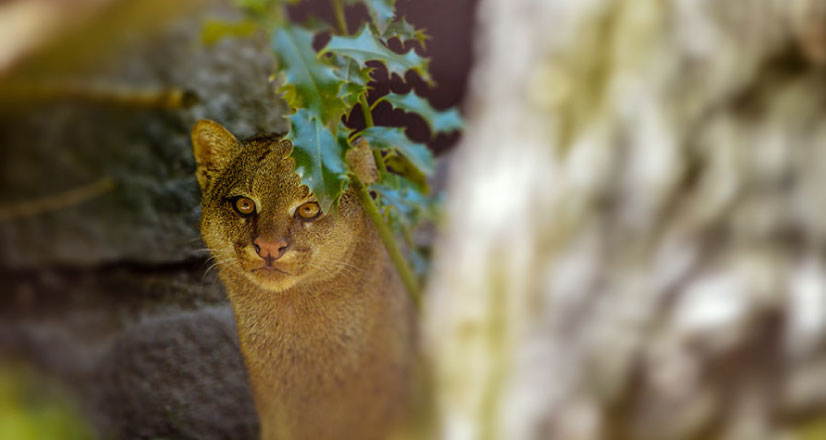
Yaguarundi, a feline that adapts to various environments. Crédito: Shutterstock.
Margay
A small-sized species with soft and spotted fur, in shades of gray, brown, and black, allowing it to skillfully camouflage in its arboreal environment. Known for being mainly nocturnal and for its agility in climbing trees, it feeds on a variety of prey, including birds, small mammals, and reptiles. It is found in various regions of Peru, especially in the Amazon. It shares lowland habitats with jaguars, pumas, and ocelots.
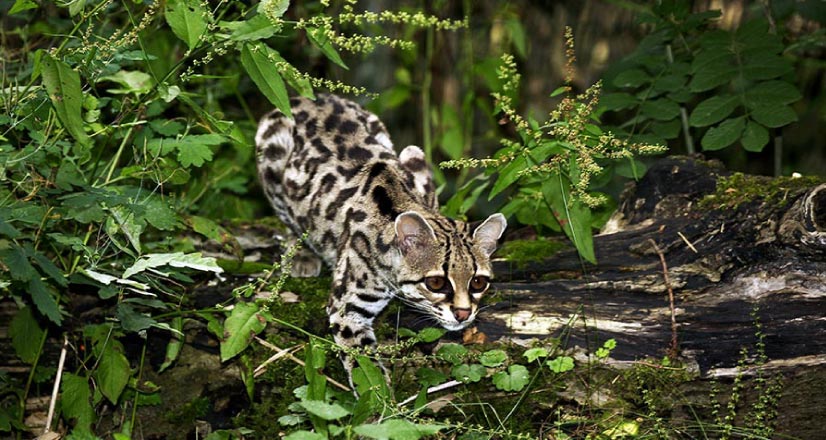
Margay stands out for its agility in climbing trees. Crédito: Shutterstock.
Ocelot
A medium-sized feline. Its name is due to the ocelli (round spots with a darker border) found on its fur, providing effective camouflage in its environment. Famous for being a nocturnal hunter and an excellent climber, it adapts to different types of habitats, from dense jungles to coastal forests, and feeds on a variety of prey such as rodents, birds, reptiles, and small mammals. In Peru, it lives in the Lowland Jungle and the Pacific Tropical Forest ecoregions in Tumbes, up to 1800 meters above sea level. It also inhabits the Q’eros-Kosñipata Regional Conservation Area in Cusco.
Oncilla
One of the smallest felines in South America. Its thick fur is light golden brown with well-defined black rosette spots. It is mainly nocturnal, and its large dark brown eyes help it hunt and climb trees effortlessly. Its diet consists of rodents, small marsupials, birds, and reptiles. It primarily lives in humid and rainy forests. Its habitat is exclusively forested, with a preference for forests up to 3000 meters above sea level.
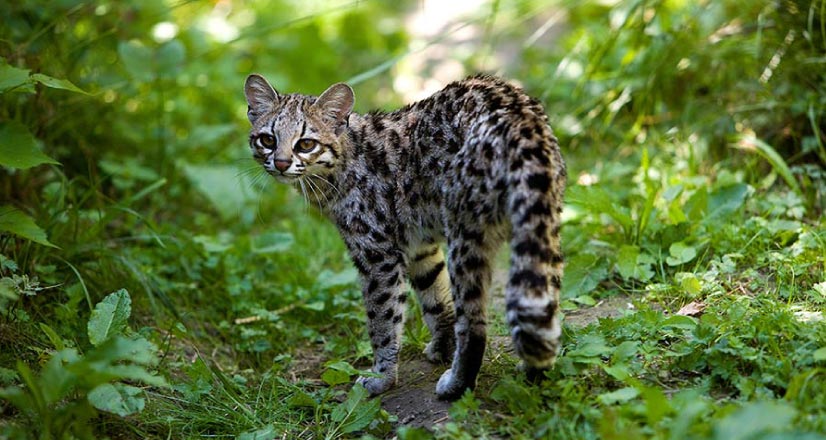
Oncilla, one of the smallest felines in South America. Crédito: Shutterstock.
Follow us on social media
Facebook | Instagram | Twitter | TikTok | YouTube