

Written by:
peru.travel
Tuesday, March 7, 2023
In this Page
Peru is a country of millenary history, of stories and myths on which the most impressive civilizations were built, such as the Inca empire. In these different cultures, there were female representations that, to date, continue to be venerated in different parts of the country. "In the Peruvian environment, the presence of deities and female characters was prolific since 3000 BC.", explains author Maritza Villavicencio in her book "Poder femenino, 5000 años de historia en el Perú" (Women's Power, 5000 years of history in Peru).
Precisely, the figure of the woman has been associated with fertility, as well as mysticism, abundance or power. From different magical-religious concepts, as Villavicencio explains, a great deal of research has been written about the participation of women in ancient Peru, highlighting different characters. Here we bring four representations, whose remains or celebrations are linked to destinations that you can approach during your visit to the country.
Wari Queen
In 2012, a group of local and foreign researchers and archaeologists made an astonishing discovery: the remains of 58 noble women, including four queens or princesses, in the Huarmey Castle, located in the Ancash region. One of these remains was baptized as the "Wari Queen" or "Queen of Huarmey", due to the amount of jewelry and textiles found around it. If you want to learn more about the Wari culture and the history of this character, you must visit this destination.
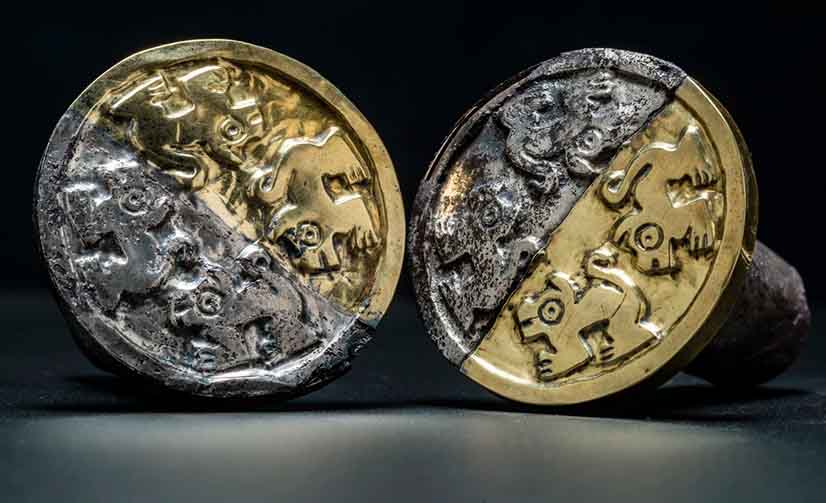
Jewels from the tomb of Wari Queen. Credits: Robert Clark & National Geographic Creative.
The Lady of Cao
The tomb of the the Lady of Cao was discovered in 2005, marking a milestone in the understanding of ancient pre-Hispanic societies: because of the presence of a woman of the Mochica hierarchy. She was found inside a lavish funerary bundle, wearing emblems of power such as crowns, diadems, ceremonial truncheons and her valuable collection of gold and silver nose rings. Finely crafted tattoos were evident on her arms and feet, representing religious power. Currently, her mummified body is located in Magdalena de Cao, in the region of La Libertad.
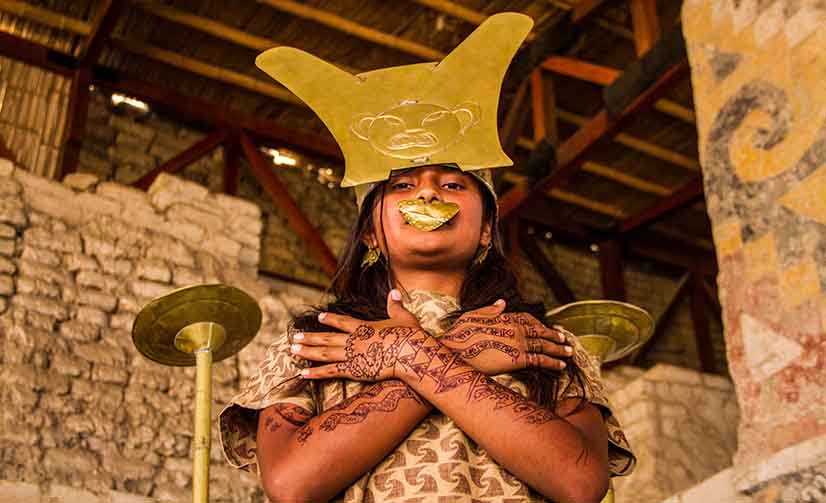
Staging of the presentation ceremony of the Lady of Cao. Credits: Eliana Obando / PROMPERÚ.
Priestess of Chornancap
Within the Lambayeque culture, the greatest female exponent was the priestess of Chornancap. Although the Lord of Sipan was the maximum representative of this culture, about 180 objects were found in the tomb of this deity, including a ceremonial scepter, earrings, a crown, metal cups, bracelets and necklaces. Her remains are in the Brüning National Museum of Archaeology, in the Lambayeque region.
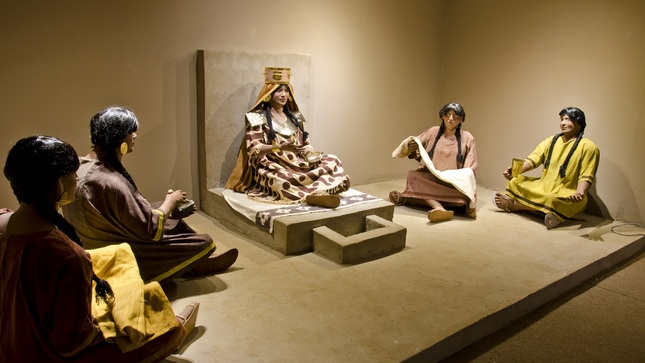
Representation of the priestess of Chornancap. Credits: Brüning Museum.
Mama Huaco
According to different researchers, Mama Huaco was considered a warrior, linked to various stories about the formation of the Inca empire. During the 18th century, she was represented -almost always- next to Manco Capac, who was said to be his wife or mother.
Source:
Women's power, 5000 years of history in Peru (2018). Villavicencio, Maritza.
Pedro de Osma Museum (2016)
The face of an ancient Wari queen reconstructed for the first time (2017) National Geographic.
Follow us on social media
Facebook | Instagram | Twitter | TikTok | YouTube