

Written by:
peru.travel
Friday, September 25, 2020
In this Page
Visiting the Pacaya Samiria National Reserve in the Peruvian Amazon will always be a great experience, not only because it is a natural space with great importance for wildlife, but also because it is a place that promotes research and conservation of biodiversity. A great variety of aquatic and terrestrial ecosystems are housed in this reserve.
Flexible ecosystem
The surface of this reserve constitutes 1.5% of Peru's territory and it is the largest Amazon area under protection in the world. Its lands are flooded during the rainy months (October and April), when the rivers overflow and cause nearly 80% of this territory to be covered by water.
That is why the environment is both terrestrial and aquatic. When the rains cease, the river beds return to their natural state and again produce small lagoons and rivers. The reserve offers us, then, a flexible ecosystem.
Flora and fauna refuge
Among the most unusual animals that can be observed in the reserve is the largest jungle fish: the paiche. Some specimens are two meters long and weigh about 150 kg. The paiche is the monarch of the Amazon rivers. The charapa turtle is another endemic species. It lives in rivers and lakes, and is one of the largest water tortoises in the world. The charapa turtle can measure up to one meter and weigh up to 50 kg.
In the reserve it is also possible to observe the anaconda, one of the largest snakes in the Amazon. Its impressive anatomy of ten meters long and about 250 kg of weight make it look really intimidating. However, contrary to popular belief, these types of snakes are not poisonous, although it is better to be appreciated from a distance.
On the other hand, there are varieties of dolphins in Pacaya Samiria: the gray dolphin and the pink dolphin with a long peak and a bulging head. The natives attribute certain magical powers to these species, like the ability to fertilize women who approach the banks of rivers at night.
In the reserve, the existence of more than 1,200 plant species grouped in more than a hundred families has been documented. Orchids stand out, of which 22 species have been found, and palms, with 29 varieties. The aguaje is highly appreciated for its fruits that are consumed by animals and humans.
In addition, it is possible to find a great variety of medicinal plants and large trees such as the lupuna.
How to get there?
If you are in Lima, you will have to take a flight to Iquitos, which lasts approximately one hour and 45 minutes. Two hours from there by road is the town of Nauta, one of the entrances to the reserve. The other option is to enter through Requena, a city 48 hours away by boat from Iquitos. There is a fee for the right of entry.
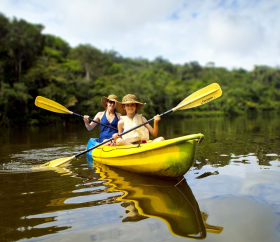
The tour of the reserve is strictly through the rivers and it is possible to stay in tourist lodges located on the banks.
The temperature ranges between 71 and 95 °F, and the rains are permanent, so it is recommended to wear waterproof clothing; hat or cap, sunglasses, binoculars, sunscreen, and insect repellent. Also, it is preferable to be vaccinated against yellow fever. The rest is a spirit of adventure.
Sources: Sernanp / denomades / pacaya-samiria.com
Follow us on social media
Facebook | Instagram | Twitter | TikTok | YouTube