

Written by:
peru.travel
Monday, July 20, 2026
In this Page
One of Peru’s largest natural sanctuaries.
The Paracas National Reserve in Ica is a sanctuary that brings together Peru’s most important landmarks. It is home to the only red sand beach in South America — one of just five in the world — and to Mendieta, where liberator Jose de San Martin, regarded as one of the heroes of Peruvian Independence. Beyond its history, this natural sanctuary is a playground for adventure sports, birdwatching, and swimming in turquoise waters.
Just four hours from Peru’s capital, Lima, the intense Ica sun welcomes visitors from high above. The drive into the reserve from Santo Domingo takes about 90 minutes to 2 hours. As the first vehicles enter the reserve, visitors may spot Inca terns — one of the area’s signature bird species — guiding the way toward the first stop: the famous rock formation known as "La Catedral" (The Cathedral). From the viewpoint, visitors can admire this coastal formation, sculpted by wind and waves to resemble the domes of traditional cathedrals.
Paracas National Reserve spans 335,000 hectares and is home to 200 bird species, along with a wide variety of marine wildlife. The scenic beauty of this natural sanctuary is truly remarkable.
Here, visitors can see how the sand and sea take on a darker tone due to the igneous rock known as "pink granodiorite." Only five similar beaches exist in the world: one in Peru, one in Morocco, one in Hawaii, and two in Greece.
You may also be interested in: Discover everything about the Ballestas Islands in Ica
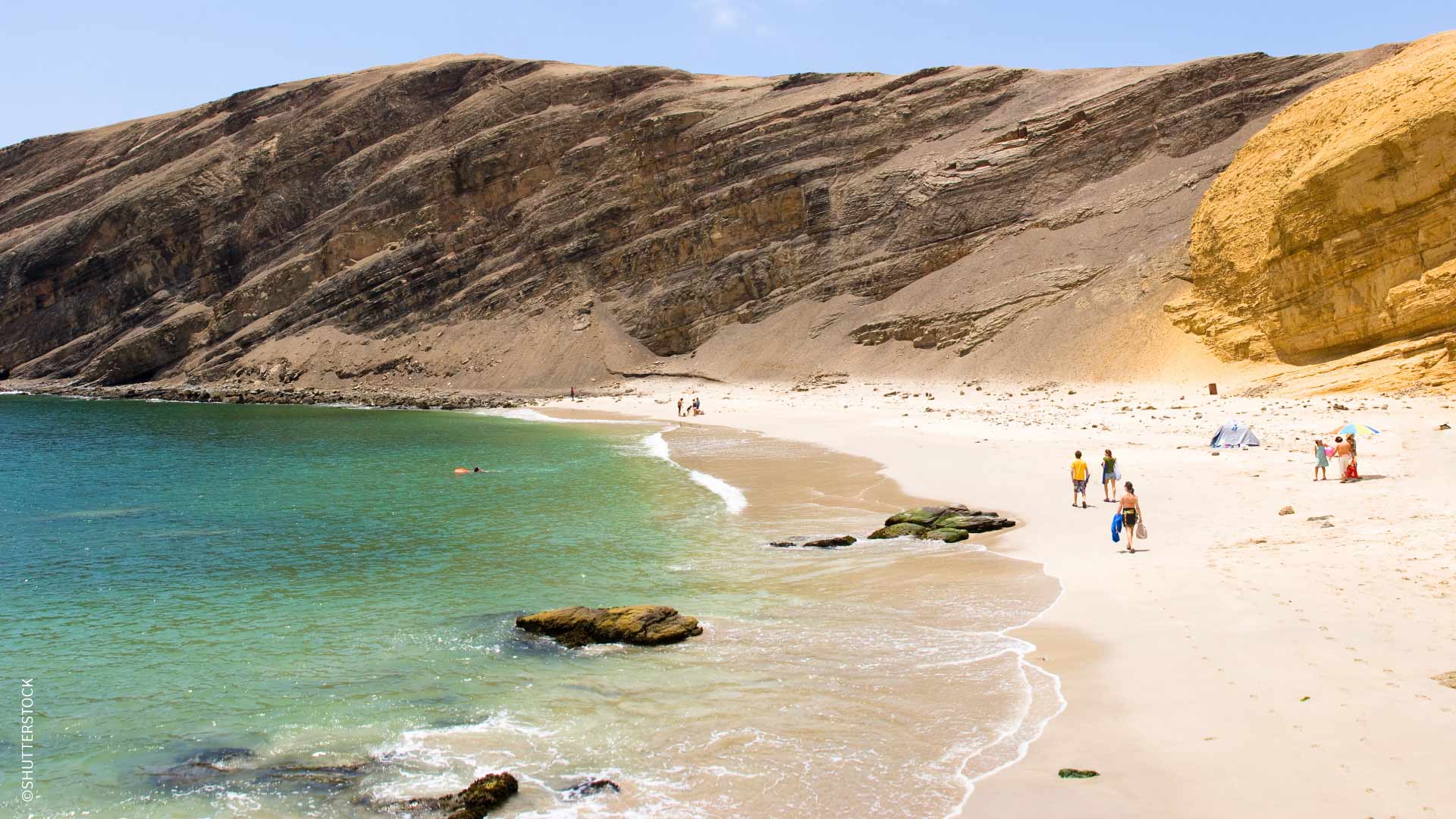
Views of La Mina Beach in the Paracas National Reserve. / ©SHUTTERSTOCK
A few kilometers ahead, lies La Mina Beach. This scenic marvel, with its striking turquoise waters, welcomes visitors descending a staircase alongside the rock formations, where the waves offer relief from the intense sun. It is an ideal spot to enjoy with family or friends, or to relax before diving into adventure sports. The Paracas National Reserve also offers other swimmable beaches, such as Yumaque Beach and Raspon Beach.
What places to visit in Paracas National Reserve?
Keep in mind that, depending on the season, the beaches and viewpoints available for visiting may vary.
Playa Roja (Red Beach) viewpoint
One of the most iconic stops within the Paracas National Reserve is this unique beach, which gets its name from the intense reddish hue of its shoreline. This distinctive color is due to the presence of pink granodiorite, an igneous rock carried and deposited by the sea over time.
It is important to note that visits are only allowed from the viewpoint, as access to the beach and swimming are restricted to preserve its natural condition.
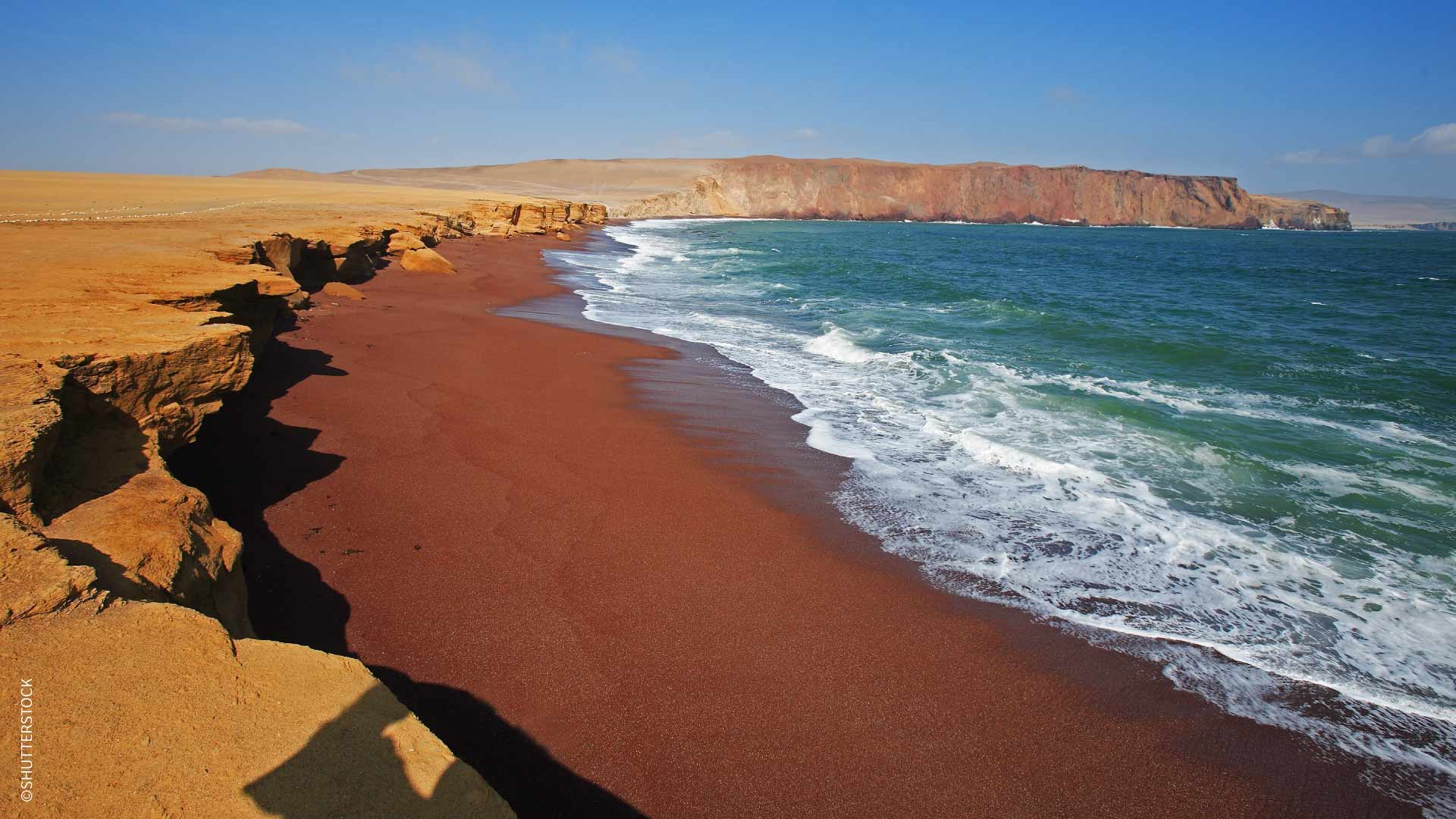
Playa Roja in Paracas National Reserve, Peru. / ©SHUTTERSTOCK
Yumaque Beach
Yumaque is another prominent beach within the Paracas National Reserve and is generally open for swimming. Stretching for 2 kilometers, it offers a peaceful space to relax, and on certain occasions, it is even possible to spot dolphins in the distance.
Supay Beach viewpoint
The name "Supay," which means devil in Quechua, refers to the force of its waters. Due to these conditions, access to the beach is restricted and it can only be admired from the viewpoint. From here, visitors can admire breathtaking cliffs formed millions of years ago, in a landscape that conveys all the intensity and beauty of the Peruvian coastline.
Julio C. Tello Site Museum
If you wish to delve deeper into the area's history, a recommended visit is the museum located inside the Paracas National Reserve. The museum exhibits more than a hundred pieces, including ceramics, textiles, and tools belonging to the Paracas Culture. Its permanent exhibition stands out for its educational content and audiovisual material, helping visitors to understand the legacy of this civilization.
The entrance fee is approximately PEN 7.50 for adults, PEN 4 for university students, and PEN 1 for school students.
Paracas Interpretation Center
Located at the entrance to the Paracas National Reserve, this center is the ideal starting point for your visit, offering a comprehensive introduction to the region’s natural and cultural environment. The exhibits display local geology, flora, and fauna, while highlighting the history of early human settlements and the period of guano extraction in the Ballestas Islands.
Follow us on social media
Facebook | Instagram | X | TikTok | YouTube