

Written by:
peru.travel
Wednesday, August 13, 2025
In this Page
Peñico, an ancient city connected to Caral, reveals the cultural and architectural richness of the first civilization of ancient Peru.
In the vast history of ancient Peru, some civilizations—like Caral—continue to spark curiosity and admiration for their age and complexity. The urban center of Peñico is part of this remarkable civilization and holds immense value for understanding Peru’s pre-Columbian past.
Declarado Patrimonio Cultural de la Nación el 1 de agosto de 2002, Peñico was founded during the Early Formative Period (1800–1600 BC) and is located on Peru’s north-central coast, specifically on the left bank of the upper middle valley of the Supe River. Thanks to its strategic location, this center served as a unifying point between the coastal and highland villages of Supe and Huaura—earning it the name "City of Social Integration".
Caral and Its Lasting Legacy
The Caral civilization, located in the city of Lima, eis considered the oldest in the Americas and marks a fundamental milestone in global archaeology. It is renowned for its advanced architecture—pyramids, sunken circular plazas, and residential complexes—that reflect a well-organized, peaceful society with remarkable knowledge in agriculture, engineering, and astronomy.
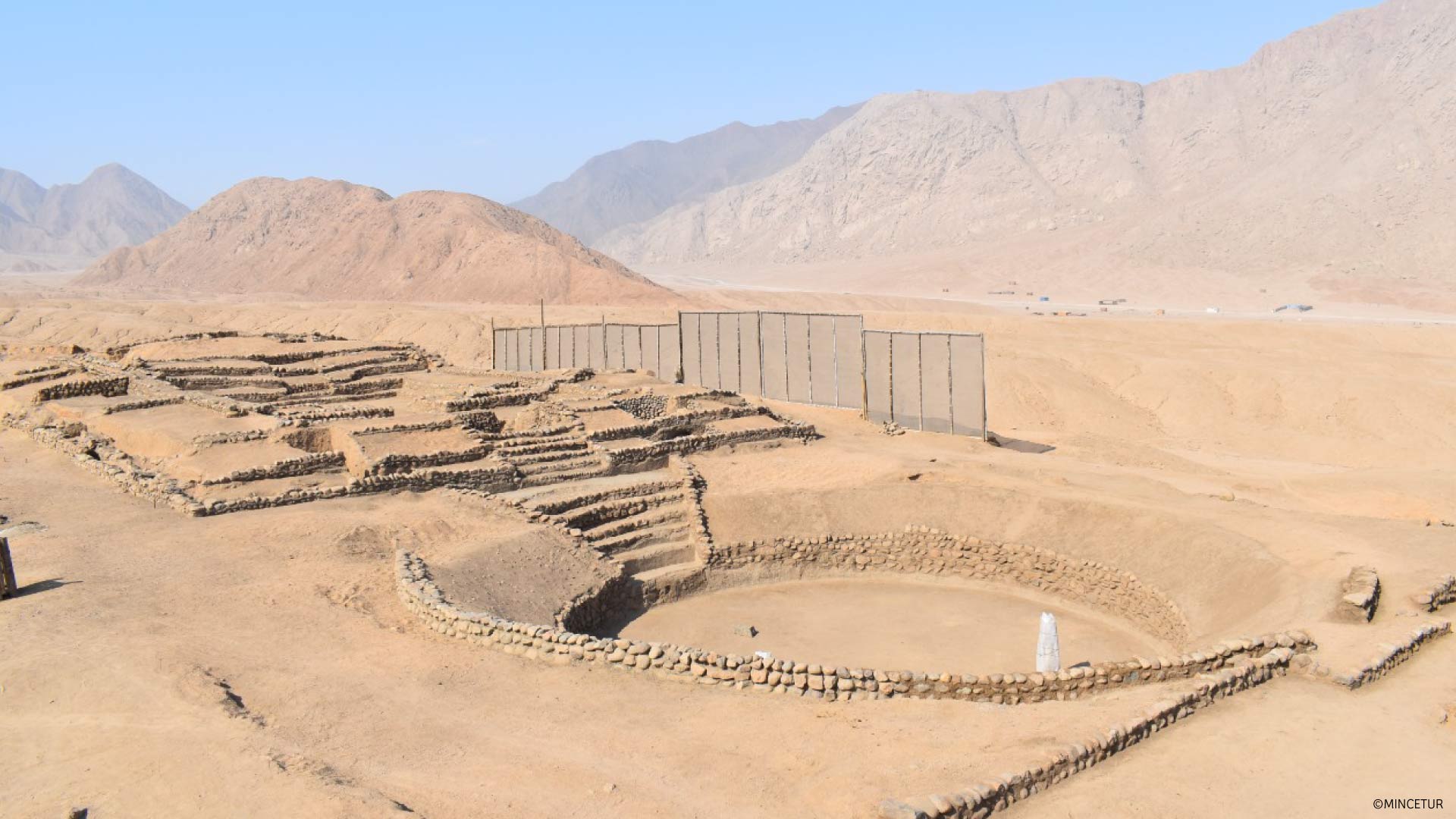
In this sense, one of the greatest contributions of the Caral civilization was its lasting presence through the founding of new cities like Peñico. This urban center stands out for its monumental architecture, featuring ceremonial halls built atop large stepped platforms, along with stairways, courtyards, and carefully designed walls.
These structures were both functional and symbolic. According to archaeologists, the temples were used for religious rituals that brought the local population together on significant dates.
You may be interested in: Did you know that Caral has a virtual museum?
Peñico’s Impact on Modern Archaeology
Peñico features architectural elements typical of the earliest complex societies in the Americas, including pyramidal structures and circular plazas. It was built on a natural ledge running parallel to the river and a large alluvial cone, surrounded by a valley and mountains that rise over 1,000 meters high.
In total, the complex spans just over 22 hectares and is divided into two main sectors:
- The first sector is located on a promontory and includes structures from different periods, most notably pyramids and terraces arranged around a sunken circular plaza.
- The second sector, located in the lower area, includes several structures, most notably a building made up of platforms and an adjoining circular plaza.
A total of 18 buildings have been identified at this archaeological site. Among them, the structure known as "B2" stands out for its impressive sculptural reliefs. It forms part of the Major Public Building B1–B3, located in Sector B of Peñico’s urban center.
Inside this building are remarkable representations of pututus—musical instruments made from seashells—carved into the walls of a square room.
The pututu was highly valued in Andean cultures for its powerful sound, which could carry over great distances, as well as for its deep symbolic meaning. It was used to call gatherings, mark significant events, and convey social status.
Researchers consider this structure the most important in Peñico’s urban history. Its strategic location, monumental scale, and architectural complexity suggest that it was the setting for the most significant administrative and ceremonial activities in the urban center.
Among the most important findings in this Major Public Building are sculptures modeled in unfired clay, depicting human figures, animals, and ceremonial objects. In addition, a large number of stone tools—such as grinders, crushers, hammers, fulling mills, and anvils—have been uncovered, providing evidence of the many activities once carried out at the site.
How to get there
Peñico is located approximately four and a half hours from Lima and can be reached by private vehicle or through tourist services. The route is similar to the one that leads to Caral: take the turnoff to the Supe Valley (Caral–Ámbar route) at kilometer 184 of the Pan-American Highway North. From there, it is another 34 kilometers to reach the site.
Looking for a unique experience that blends ancient history with breathtaking landscapes? Peñico is your next destination. Just a few hours from Lima, this extraordinary archaeological site invites you to explore ancient temples, marvel at sculpted reliefs dating back over 3,800 years, and immerse yourself in the energy of a pre-Hispanic city that once thrived in harmony with nature.
Thus, with each visit and discovery, Peñico continues to speak from a mythical past, clearly showing that Peru is the cradle of wise, creative, and deeply human civilizations.
Follow us on social media
Facebook | Instagram | Twitter | TikTok | YouTube