

Written by:
peru.travel
Wednesday, March 9, 2022
In this Page
Did you know that in the heart of the Lambayeque region is the largest and most dense formation of carob trees on the planet? Or that the enigmatic pre-Inca Sican culture developed in the same area? If you didn't know, this privileged place is the Pomac Forest Historical Sanctuary. This is a protected area, located in the province of Ferreñafe, with an immense natural and archaeological treasure that makes it an important ecotourism destination in Peru.
Visiting this dry forest paradise offers the opportunity to connect and feel the natural environment like nowhere else. Its main objective is to preserve the landscape and cultural richness of the place, as well as the biodiversity and ecosystems that are inside. Below, learn more about this sanctuary and come to visit it on your next trip to northern Peru.
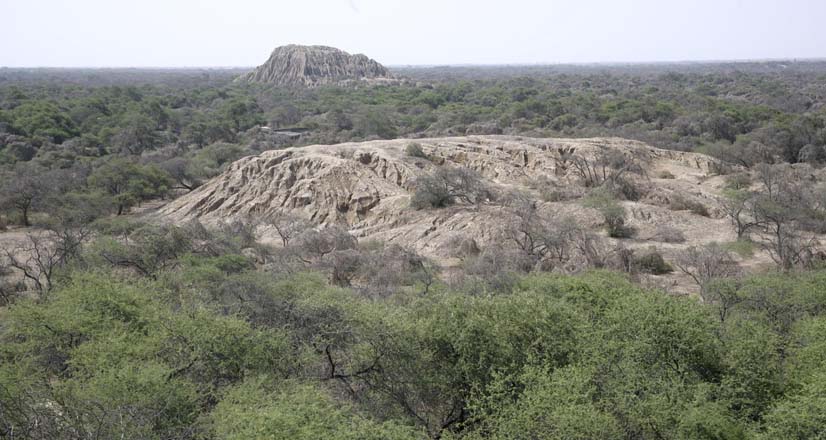
Panoramic view of the Pomac Forest, in Lambayeque. Credit: César Vega / PromPerú
Live a unique experience surrounded by nature
The area of 6,000 hectares that comprises the sanctuary is located between the districts of Pitipo, Íllimo, Tácora, Jayanca and Tucume, with Pytipo being the main entrance and Íllimo, the alternate entry. Inside, there is a large area of dry forests made up of plant species such as sapotes, angolos and carob trees, highlighting the presence of this majestic ancient tree.
It is also possible to see more than 80 species of birds in the wild habitat, including the Peruvian plantcutter and the Tumbes swallow, which makes this place an important tourist center for birdwatching lovers and visitors in general.
It is also notable the rufous flycatcher and the buff-necked ibis, which can be seen on the carob groves. Among the other species that inhabit Pómac, the presence of the wildcat and the Oecomys bicolor, an endemic Peruvian rodent stands out. Within the reptiles you can find different types such as the rattlesnake or Bothrops barnetti and the Boa constrictor ortonii.
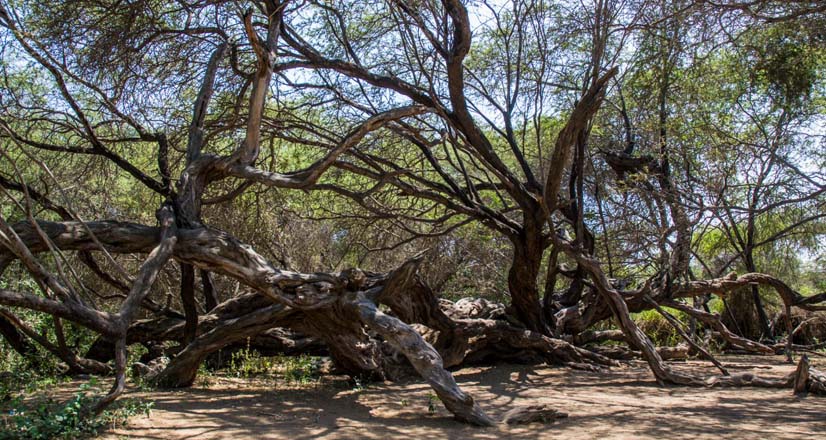
Ancient tree located in the Pomac Forest (Lambayeque). Credit: PromPerú.
As for history, the Pomac Forest also treasures an impressive monumental and archaeological wealth, made up of 36 pyramids that belonged to the ancient Sican or Lambayeque culture, an important civilization linked to the legend of Naylamp, the iconic Golden Tumi, the Lord of Sican and the Priestess of Chornancap. As you can see, this attraction gives you wilderness, culture and history, a fascinating mix that guarantees the most unforgettable experiences.
How to get there?
To visit the Pomac Forest, there are two easily accessible routes. The first one is from the city of Chiclayo, crossing the province of Ferreñafe and the district of Pítipo, until reaching the area called La Curva. Through this 41 km route, which takes approximately 45 minutes, you will reach the Interpretation Centre of the Sanctuary.
The other route also starts in Chiclayo, but unlike the first one, it crosses the district of Íllimo. Through a 40-kilometer road, which takes about 40 minutes, you will locate the entrance checkpoint to the sanctuary. During the rainy season, between December and March, we recommend that you access the detour towards the Poma III gate, which is located close to Puente Machuca, in the south of the district of Pacora.
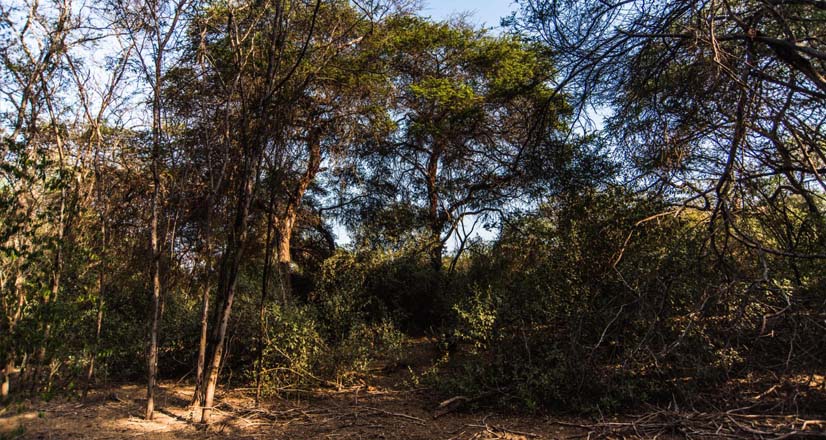
Carob trees located in the territory of the Pomac Forest (Lambayeque). Credit: PromPerú.
Sources: Gestión / Sernanp
Follow us on social media
Facebook | Instagram | Twitter | TikTok | YouTube