
Written by:
peru.travel
Tuesday, October 27, 2020
In this Page
During the years 1200 and 1465 A. C., the majestic Chimú civilization settled in the northern desert of Peru and had as its epicenter the citadel of Chan Chan, recognized as the largest mud city in America. It was through imposing walls and irrigation channels that the Chimúes built this citadel in the middle of the dunes, which was home to about 30,000 inhabitants.
Heirs of the Mochicas and the Huari, the Chimú culture grew and developed long before the Incas became the largest civilization on the continent. Their ability to build complex canal systems to bring water to an arid area, added to his remarkable work in ceramics and goldsmithing, made this culture one of the most important in the history of Peru.
Architectural gem
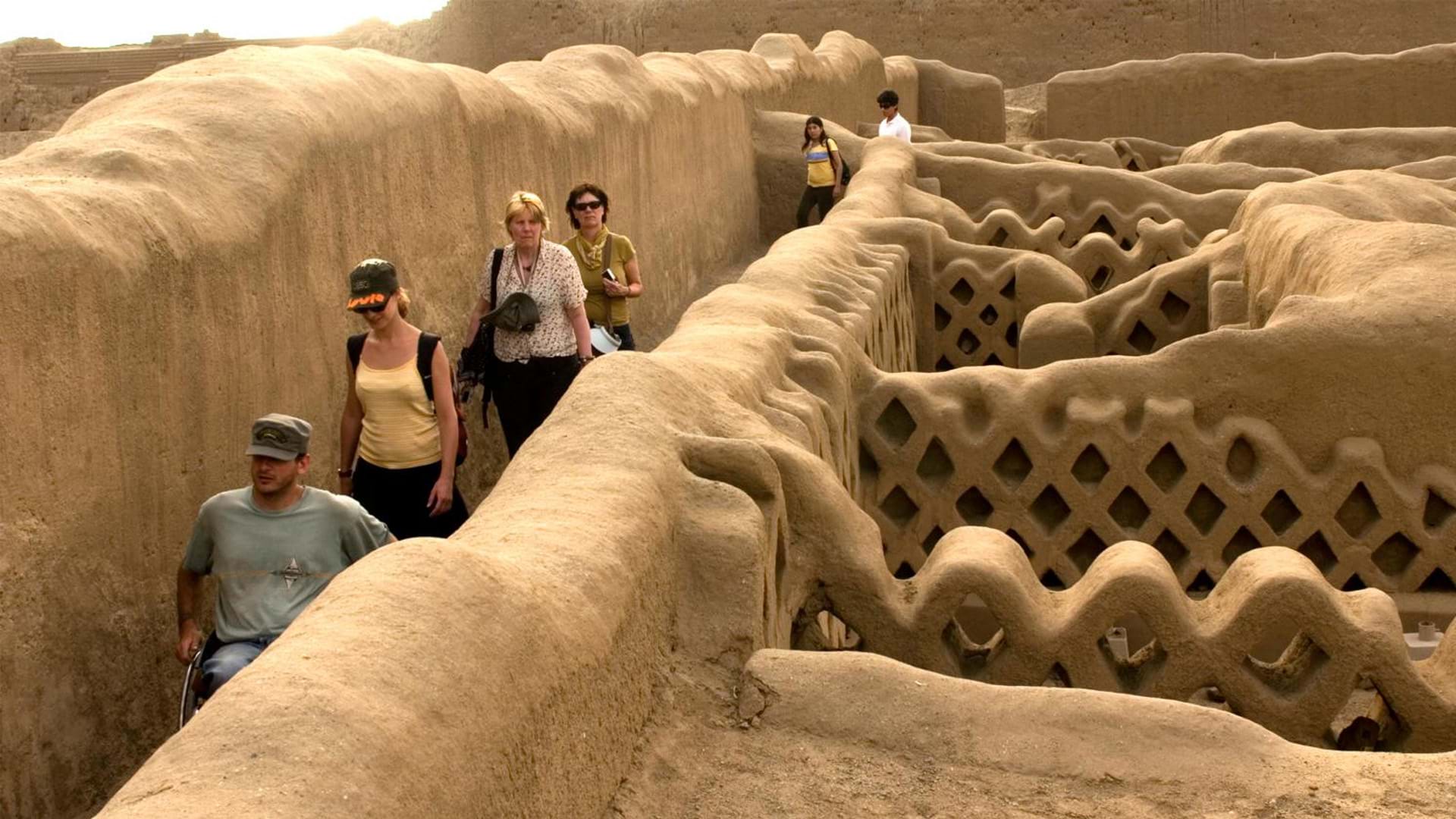
Like most of the large walled complexes, Chan Chan has a central access in the northern part that connects to the outside. From this main entrance to the open space of the plaza you can see a large number of hallways and corridors in the form of labyrinths that served for the transit of the population.
Contrary to popular belief, Chan Chan was not an orderly city, because inside the complex, the roads were continually blocked. Even so, we can appreciate a certain order of its internal spaces discovered through the years.
Chan Chan is made up of eight large fenced citadels that sheltered small cities inside. These are: Chayhuac, Uhle, Tello y Laberinto, Gran Chimú, Velarde, Bandelier, Rivero and Tschudi. Each complex was delimited by a high mud wall up to nine meters high, with bases of four and a half meters.
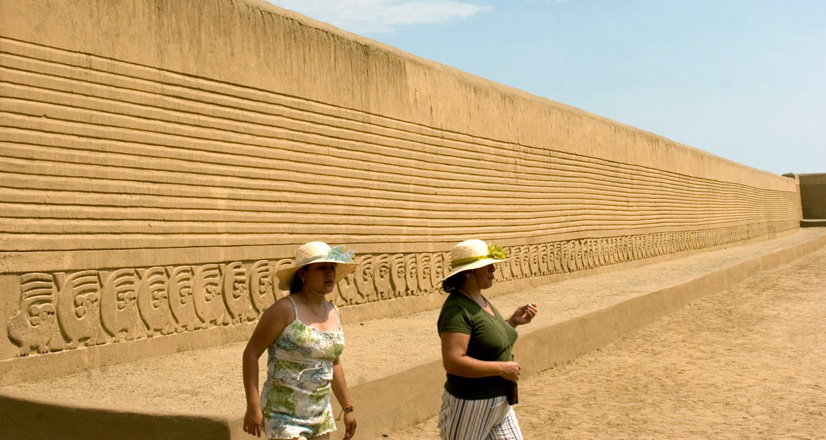
Chan Chan has a central access in the northern part that communicates abroad. Credit: PromPerú.
Planned spaces
The highest-ranking rulers and nobles settled in the center of the city, in palaces built with adobe and mud. Apparently, each complex belonged to a ruler who needed to build his own headquarters of government. In the surroundings, there are about 30 enclosures with certain similarities to the palaces. These had water wells, patios, and reservoirs. In these spaces lived the nobles of lower hierarchy.
The wide patios surrounded by decorated walls were the scene of various activities, including celebrations and rituals. During the tour of the ceremonial and administrative palaces of Chan Chan, you will be able to observe the great scenographic display of beautiful tiles in high relief that dress its murals.
These walls show different representations of fish in both directions, which can be interpreted as the two currents that mark the Peruvian coast: the Humboldt, heading south, and the Niño, which comes from the north. In addition, designs of waves, fishing nets and pelicans are observed.
How to get there?
To get to Chan Chan, you must first travel to Trujillo, capital of the La Libertad region. From Lima, you can go by bus, with a journey of approximately 7 to 8 hours. The cost fluctuates between 60 and 100 soles depending on the type of service on board. Another option is to go by plane, with a 35-minute itinerary.
To get to the citadel from Trujillo, it is enough to travel ten minutes by bus. In Chan Chan there is a site museum inaugurated in 1990 where the entire historical and evolutionary process of the Moche valley is explained by a guide, and where different pieces that belonged to the Chimú culture are also appreciated.
Sources: National Geographic / demisviajes / arqueologiadelperu / Denomades
Follow us on social media
Facebook | Instagram | Twitter | TikTok | YouTube