

Written by:
peru.travel
Friday, July 24, 2020
In this Page
The Parque de la Reserva stands greenish beyond the confines of Lima Center. Many of the people who pass by daily do not imagine the history behind their benches and trees.
To learn a little more about the origins of the Parque de la Reserva, we would have to remember the history of Peru. Some passages are heartbreaking, since their origins were stained with pain and blood, due to the Guerra del Pacífico that confronted Peru and Chile, between 1879 and 1884. However, its construction served to commemorate a group of heroes who immolated themselves for their nation: Peruvians who gave their lives for their homeland. This iconic Lima park stands in honor of them.
It was 1881 and the Chilean troops had a predominance in Lima. The Peruvian artillery was decimated: there were an incalculable number of dead, wounded and deserters. So there was a national call for citizens who had not yet touched guns to enlist to defend their nation. Merchants, teachers, lawyers, citizens of all kinds and conditions began to arrive. But they were not enough. Those over 16 years old began to be admitted. Even in the face of their refusal, they recruited even younger Peruvians, who were just entering puberty. Hard to believe, but true.
These groups with little experience were called Batallones de Reserva. And despite having the status of inexperienced, they were as brave and courageous as the frontline soldiers. They concentrated and were trained where the Parque de la Reserva currently operates to carry out their main mission, which was to stop the advance of Chile, which seemed to have conquered Lima. And despite the difficulties and adversities, they did their job.
Motherland Monument
Augusto Bernardino Leguía y Salcedo was 18 years old when he joined the Batallones de Reserva. And who would say that, after the storm, and after preparing and becoming a prosperous businessman, Leguía was twice elected President of Peru (his second term lasted eleven years due to successive re-elections). He governed a total of 15 years, within which he ordered the construction of the Parque de la Reserva, in honor of the reservists who fell in the Guerra del Pacífico during the battles of San Juan and Miraflores, in 1926.
The 16 hectares currently occupied by the Parque de la Reserva served as a place of study for the former students of the Escuela de Agricultura. These were transferred to the Ate valley, in La Molina, and thus the construction of this iconic park began. After almost three years of hard work, which had the support of the French architect Claude Sahut and the intervention of local artists such as the indigenous painter José Sabogal and the sculptors Daniel Vásquez Paz and Daniel Casafranca, the monument saw the light on February 19, 1929.
Despite the fact that the design of the park took the form of the classic English gardens, the influence of Peruvian workforce and its details can be seen in every corner of this oasis strategically located between the busy Arequipa, Petit Thouars and Luis Bedoya Reyes avenues, in the neighborhood of Santa Beatriz, in the Cercado de Lima.
A new attraction
The Parque de la Reserva had different renovations. The most remembered change was in 2006. Since that date, the park contains within it the famous Circuito Mágico del Agua, a tourist attraction that has 13 different water fountains that are technologically controlled to provide a show to the thousands of spectators who usually attend each month. However, the original purpose for which the Parque de la Reserva was built should not be forgotten: to pay tribute to the martyrs who gave their lives to defend Peru.
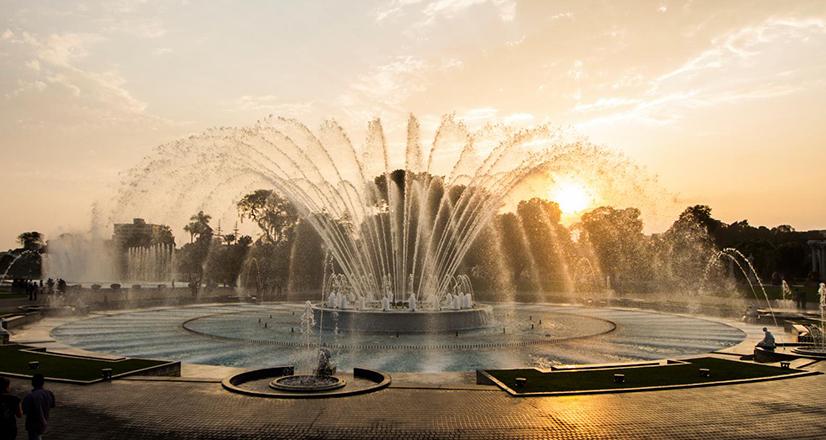
The park contains within it the famous Circuito Mágico del Agua, a tourist attraction that has 13 different water fountains. Credit: César Vallejos / PromPerú.
Sources: El Comercio / La Mula / Web Parque de la Reserva
Follow us on social media
Facebook | Instagram | Twitter | TikTok | YouTube